

Semantic Scholar
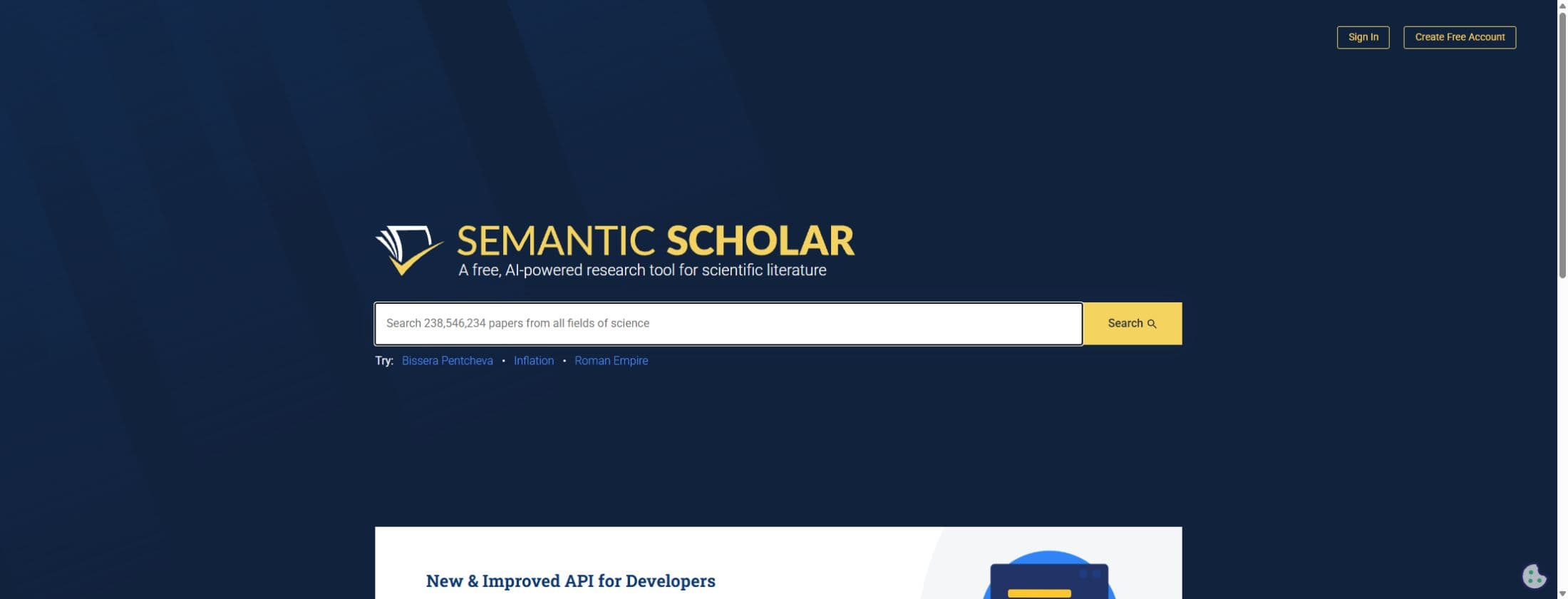
Semantic Scholar: free AI-powered academic search
Search scientific papers, explore citations and organise a research library with Semantic Scholar, Ai2’s free academic discovery tool.
FreeAccount optional
- Access
- Free
- Available on
- Web, API
A free starting point for academic discovery
Semantic Scholar helps you find scientific literature and follow the connections between papers. Built at Ai2, it combines academic search with author profiles, publication metadata and citation records. Filters narrow results by details such as publication date and venue. Open-access links are supplied where available, while other papers still require publisher or institutional access.
Its AI features make parts of the literature easier to scan and revisit. TLDRs give short summaries for supported papers, and Ask This Paper answers questions with supporting statements on a limited set of English-language papers. Semantic Reader adds citation cards and other reading aids to supported documents. These features have different coverage, so they are not available on every search result.
A free account adds library folders, bulk citation exports, research recommendations and alerts. Public folders can be shared with collaborators, while Research Feeds use saved papers and feedback to suggest related work. Developers can also use the Academic Graph, Recommendations and Datasets APIs. Those resources have their own access limits, attribution requirements and data licences.
Best for
- Researchers discovering and tracing literature
- Students building a reading list
- Developers working with scholarly metadata
Limitations
Index coverage and full-text access vary. AI summaries and citation signals do not establish the reliability of a study, and the website does not support Boolean or wildcard search.
Semantic Scholar features
Filtered academic search
Find papers across scientific fields and narrow results by publication date, authors, venues and other available filters.
Citation and influence links
Explore references and citing papers. Highly Influential Citations highlight relationships identified by a model, rather than assigning a quality verdict.
TLDRs and paper questions
Scan short summaries and ask supported papers questions with source statements. Coverage differs by paper, field and language.
Semantic Reader
Read supported papers with contextual citation cards and navigation. Skimming Highlights mark goals, methods and results on selected English computer-science arXiv papers.
Libraries and research feeds
Save papers in folders, share public collections, export citations and receive recommendations or new-paper alerts through a free account.
Scholarly data APIs
Access paper, author and citation records, recommendations and datasets. API throttling, attribution and underlying data licences apply.
Semantic Scholar pricing
Free to use. Plans and included features vary. Visit Semantic Scholar for full plan details and current offers.
Technical specifications
Search and research
| Feature | Semantic Scholar |
|---|---|
| Source corpus | Scientific literature across many fields, with paper, author, venue and citation records. Available full text depends on the source.Discovery index; not universal full-text access |
| Citation workflow | Reference and citing-paper links, machine-identified Highly Influential Citations and citation-format exports. Influence is not a study-quality score.Paper and citation records |
| Document inputs | Search and read indexed papers; Semantic Reader is available for selected papers, including most arXiv papers.Indexed-paper reading |
| Research workflow | Filtered paper search, TLDRs, selected-paper questions, saved library folders, Research Feeds and email alerts.Account required for saved and personalised features |
| Export formats | Copy citations in BibTeX, MLA, APA or Chicago. Signed-in library users can select papers for bulk citation export.Citation records, rather than generated review tables |
| API access | SupportedAcademic Graph, Recommendations and Datasets; introductory API-key limit 1 request/second, public access shared and throttled |
Semantic Scholar alternatives
Other tools for scientific answers, citation context and structured evidence reviews.
Consensus
Cited answers and research summaries drawn from scientific papers.
Compare with Semantic ScholarScite
Explore citation statements and their supporting or contrasting context.
Compare with Semantic ScholarElicit
Screen studies and extract evidence into structured review tables.
Compare with Semantic ScholarSemantic Scholar FAQs
Is Semantic Scholar free?
Yes. Academic search and accounts are free. A free account adds libraries, recommendations and alerts; it does not remove publisher paywalls.
Does Semantic Scholar provide every paper’s full text?
No. It offers open-access options where available, but some papers can only be read on a publisher’s site through paid or institutional access.
Can I use Boolean search in Semantic Scholar?
The website does not support Boolean operators or wildcards. Quoted text and the available search filters can narrow a query.
Does Semantic Scholar have an API?
Yes. It offers Academic Graph, Recommendations and Datasets services. Some endpoints require an API key; the published introductory key limit is one request per second. Attribution and data licences apply separately.
Is this your product? Claim this page to update your listing.